Author Archives: theglowery

Unknown's avatar

About theglowery

This picture was taken in Salt Lake City in June, 2014, with my good friend, Ernie Horstmanshoff. I am a writer, a photographer, and a quilter. I live in Millcreek, Utah.

African Residency USA 1526-2026

The most successful slave rebellion in the continental USA occurred in 1526, in the Ayllon Colony, at the mouth of the Big Pee Dee river in what is now South Carolina. “Slave Insurrections in the United States 1800-1865” (1938, reprint 2004) by Joseph Cephas Carroll, page 13.

Spanish colonizers had brought their skilled African slaves with them, to establish a new settlement. Local indigenous tribes were powerful, and encouraged the Africans to revolt and get away from their captors.

The words “slave rebellion” are extremely frightening, even after the passage of 500 years. If White people had revolted, and obtained their freedom, then this episode would be taught in every history class in the country.

Since “slave rebellion” is too scary, let’s call it “African Residency.” When anyone mentions that the US is 250 years old this year, gently remind them that Black people have lived here, twice as long as that.

Let’s celebrate!

Inglewood, California

I had made the logical choice: a hotel on Century Boulevard, close to LAX, with a free shuttle service. Then someone made a scheduling mistake, and I had two nights to cover before my departure. I went to ground in Inglewood.

I gave my monthly free legal clinic on La Cienega near Centinela for seven years. I knew the neighborhood, and it had everything I needed. Even after a five-year absence, I felt at home. I had passed by The Green Horse Bar, with a statue on top, many times. It is heavily gated in the front, and I have never been inside. St. Jerome’s Church is also protected by a high iron gate, no doubt a protective measure. Young men congregated outside a dispensary owned by a national celebrity. I counted at least four chicken restaurants: as they say “A chicken has a short life in Los Angeles.” RVs were lined up alongside Centinela, cramped spaces for living. The Ralph’s and the Ross Dress for Less are still there. A new Starbucks offers its products on the east side of La Cienega these days. It was 99 degrees in LA, but only 88 in Inglewood.

The three-mile taxi ride to the airport took thirty minutes. When my driver, Jose, found out I was a divorce attorney, he joked “El matrimonio es como el demonio.” We agreed that cash is still “el rey.”

Now I am back in my autumn-chilled high desert valley, but I will always love LA.

Suffering with Cancer Treatment

I was diagnosed with triple negative breast cancer on September 5, 2024. After surgery in October, I was cancer-free, but chemotherapy and radiation were recommended to avoid recurrence, and possibly other cancers. My family and friends told me “do what the doctor says.” What nerve!

Three chemotherapy infusions gave me multiple side effects, including five separate rashes, days of leg pain, terrible brain fog, heavy nausea, and a screaming nightmare, which forced a change in medication for the third infusion. I lost all of my hair, and may never grow long hair again. Each infusion required ten to fifteen days of recovery.

The five radiation treatments were not as bad, with few side effects. I finished treatment on April 16, 2025.

I could never criticize anyone for refusing treatment. I had to remind myself many times that cancer could kill me, but treatment most likely would not (there are cases where cancer treatment causes a cancer to develop, later).

Now I am healthy, as far as anyone knows. The future is uncertain, but for now, I am here.

The Persistence of Ethnic Cleansing

International law does not classify “ethnic cleansing” as a crime. Genocide is a crime, defined by the United Nations in 1948 as “the intent to destroy, in whole or in part, a national, ethnical, racial or religious group, as such.”

The current war by Israel against Palestinians in the Gaza Strip is hotly controverted. Some say it is genocide; but if the aim is only removal and occupation, that is not genocide. If Netanyahu’s aim is to retain power, and thousands of people die, is that genocide, or merely ordinary political strategy?

Klaus Mann (The Turning Point) described his attempts to warn people about Hitler and the Third Reich, after leaving Germany in 1933 to save his life. There was too much complacency. There was a widespread attitude that Hitler was an absurd little man, not capable of wreaking havoc on European civilization. Many secretly (or openly) approved of “getting rid of” the Jews. Removal plans advanced to mass extermination, while appeasement policies utterly failed.

For those in the camps (Primo Levi, Jorge Semprun), the reality was devastating. While countries were being invaded, many thousands were shipped to camps, where they were summarily executed, or held as prison labor.

Starvation is a form of torture, and a slow death. Palestinians receive little sympathy. Their suffering does not seem to be getting the reaction they deserve. Claims of anti-Semitism are used to deflect any and all criticism. The results of Israel’s policies will be harshly judged by history, in ten or twenty years. History is slow to catch up.

What can be done about ethnic cleansing in the Gaza Strip? We watch and wait, and sometimes, speak out. But let’s not be ignorant, or complacent. Mass extermination can happen again. All it takes is the devaluation of human life, to subhuman status. This is the lesson we must apparently learn, again and again.

Mechanical Breakdowns

It started in May: my toaster died. Then in June, after a 9 hour power outage, my desktop died. Last month, my laptop died. My dining room light gave out, and a replacement is on the way.

The 21st century brings many blessings, but requires frequent maintenance, often costly. I replaced the toaster – it was on sale, and the “bagel” function does not work. I replaced the desktop with an electronic typewriter – no updates, no license, no subscription fees. It was time to ditch my Word dependency.

Replacing the laptop was more expensive, but more necessary. I gave up television when I left LA in 2020, so the laptop is my “window on the world.” I also need it to do legal consulting, which generally involves e-mails with attachments.

A power bank is on order, the kind with two little cords on the sides. I am fascinated by those cords, and it seems like a good thing to have during power outages, and while traveling.

I noticed my garden hose was sometimes out of place, thrown in the bushes, or laying out in the yard. I found the culprit – he is 5 years old. His grandmother is my neighbor. They have been growing a tomato plant this summer. She says he is fascinated with the tomatoes coming out. Hoses too, apparently. I think I’ll let him slide.

Foundation of the Nation

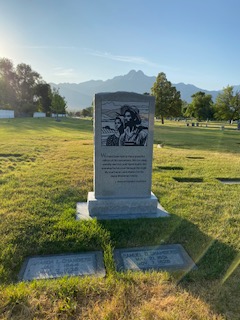
Samuel and Amanda Chambers relocated to the Salt Lake Valley in 1870, after becoming emancipated. They operated their farm in Millcreek for 50 years. A part of 3205 South was renamed Chambers Avenue in July, 2020, in their honor.

Millcreek recognizes their foundational members, even if they are not white, and male. As always, we must remember the indigenous tribes who protected and occupied this valley for thousands of years, including the Ute tribe from whom the state name is derived.

A new monument has been installed at the Elysian Burial Ground, for several Black farming families who contributed to the development and economy of the area.

Credit should be given, where credit is due.

Homegoing

I went back to California recently to visit a friend, my first visit since 2022. All of my relatives have moved away, primarily due to the expense of living there.

We went to Cuyucas Beach, with a splendid view of Morro Rock. For many years I lived within 20 miles of the Pacific Ocean. It was always a calming influence to me, through many troubles and tribulations. It is good to look at something massive, that was there before you were born, and will be there long after.

I took the Amtrak train back to Salt Lake City, first on the Coast Starlight, then the California Zephyr. The agricultural fields were almost completely empty, no doubt due to the aggressive ICE raids in progress at this time.

I grew up in the Bay Area, and it was good to see Richmond and other places in Northern California. The Sierra Mountains were green and gorgeous, and I remember the times we went camping in Yosemite, rather casually. Someone would go up on Friday night and “reserve” three camping spots for the family. I fell into the Tuolumne River at age 12, but fortunately grabbed onto a rock while my little sister found someone to help.

It is good to be able to take time to reflect on life’s passage, and not just be “stunned by the hammer” (Baldwin) of the onslaught of daily events.

My Best Shot

This picture was taken at the edge of Ortigia Island, on the east coast of Sicily. It is my favorite of 1,000 pictures, 750 taken by my friends on their iPhones, plus 250 taken by me on iPhone, 35-millimeter Pentax, and two disposable cameras.

The Ionian Sea stretches out, the clouds are soft and inviting, and the boat provides interest and perspective. It is a moment of clarity and sensation, in the midst of a hectic trip covering many miles and several locations.

Photographs preserve memories. Keep the good ones.

I Walked 200 Miles in Italy

One must make sacrifices during travel – choosing where, when and how to spend your time and efforts. I went with friends, which requires more compromise, but can provide more strength.

Our two weeks in Italy were devoted mostly to activities – visiting historical sites and museums. The Uffizi Gallery; Tuscany wine; Pompeii; the Vatican; and the Valley of the Temples in Sicily all required several hours of walking. Walking gives the benefit of time to appreciate everything, and the right to eat good food. We sacrificed late night dinners and afternoons in bars, watching the world go by. No regrets.

I studied Italian for a year before the trip, to be able to read signs and menus, understand conversations around me, and speak with the people. They were very gracious about my limited Italian. If my Italian failed me, I would revert to Spanish or a few words of English.

The sight of ancient walls and old churches next to new buildings and other signs of modern life was refreshing. Instead of tearing down everything after a mere 100 years, the people live alongside their culture and history.

Viva l’Italia!